A world built in circles

Enormous settlements before the state. Painted pottery that appears to move. Houses burned with more timber than they took to build. Thousands of dead almost nowhere. And a chronology still moving beneath our feet.

c. 5050–2950 BCE · approximate regional rangeRO · MD · UA45 indexed sources
Circles becoming a settlement and a spiralA contemporary animated composition of concentric house marks, paths and painted bands.

A contemporary visual gesture inspired by documented settlement rings and ceramic grammars. The generated pattern is a contemporary study of rotation and counter-movement.

Enter the circles ↓

“One phase was defined before it was found, and never was found.”

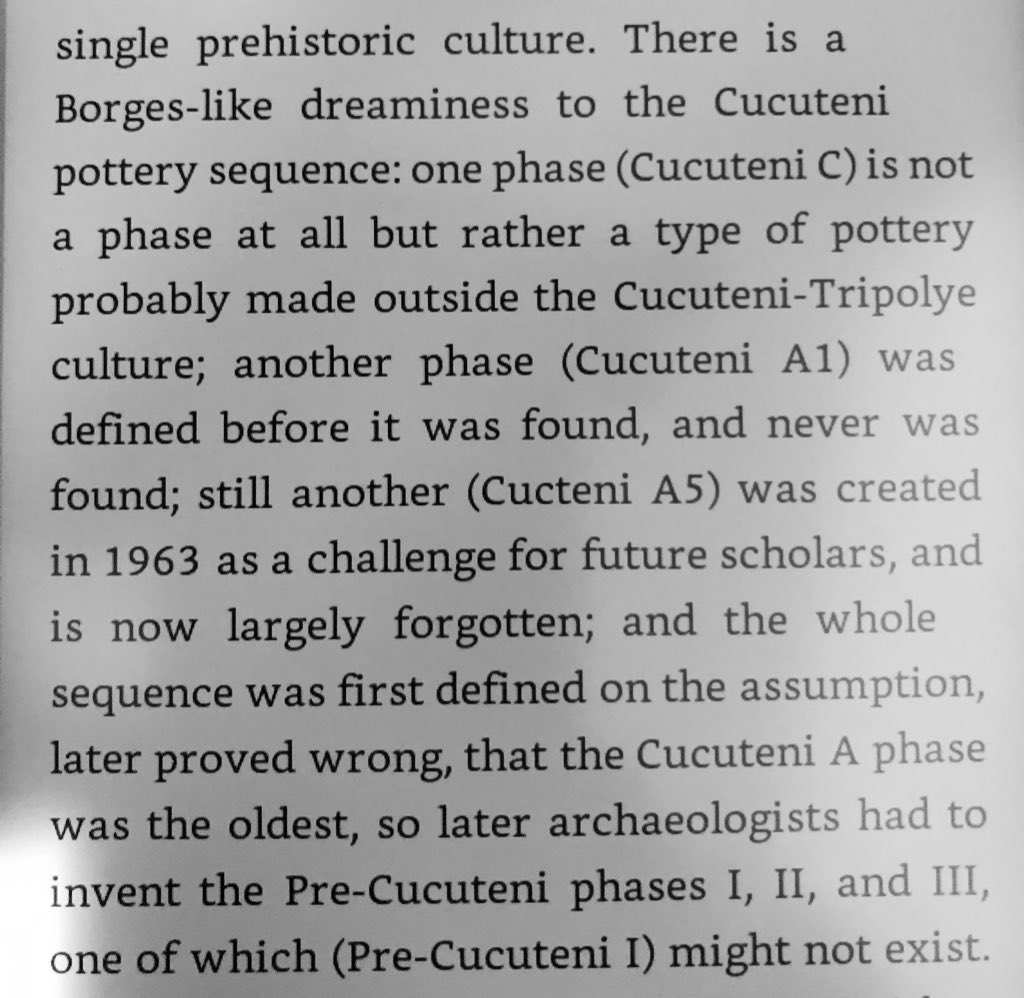
David W. Anthony calls the inherited pottery sequence “Borges-like.” The passage names the categories behind the joke: Cucuteni C was a pottery category with unstable temporal status, Cucuteni A1 was defined before it was found and remained elusive, and Cucuteni A5 was created as a challenge for future scholars. S01 S21

Photograph of page 164 showing David W. Anthony’s Borges-like passage about the Cucuteni pottery sequence
David W. Anthony, The Horse, the Wheel, and Language (2007), p. 164.
01 · Before the names

The people did not call themselves Cucuteni.

Nor Trypillia. Those are places—one in today’s Romania, one in today’s Ukraine—that lent their names to different histories of archaeological discovery.

“Cucuteni–Trypillia” is an : a model used to gather recurring forms of pottery, houses, settlements and practices across more than two thousand years and a territory larger than many modern countries. It is useful. The category gathers recurring material patterns across more than two millennia.

We do not know the languages these communities spoke, the names they gave their settlements, or whether people at opposite ends of the distribution understood themselves as belonging to one world. The hyphen keeps two scholarly traditions in view while the many local traditions beneath them remain visible. S23 S34

Well supportedDates, objects, mapped structures, chemical and biological measurements.
PlausibleInterpretations that fit several independent signals.
DebatedLive alternatives with meaningful scholarly disagreement.
UnknownQuestions the archive may never let us settle.

This project keeps those levels visible. Wonder does not require pretending that uncertainty is emptiness. Sometimes uncertainty is the most exact description we have.

02 · The chronology labyrinth

A pot can tell time. It cannot tell it alone.

For much of archaeology’s history, changing styles of painted pottery were the clock. The clock worked—until researchers asked it to run at the same speed across mountains, river basins and research traditions.

orders vessels by shape, paste, firing and decoration. If one type repeatedly lies below another, it can establish sequence. But a ceramic phase may last differently in two regions, overlap with another label, or describe a social connection rather than a period.

New , often using , allows those sequences to be tested. Recent research finds robust local and regional sequences while the single macro-sequence becomes unstable. S02 S24 S25

At Stăuceni–Holm, secure contexts and dates in the fortieth and thirty-ninth centuries BCE may force a reconsideration of where Cucuteni A3 sits. The revision makes the chronology more exact. S03

Move between two clocks
Ranges are schematic; site-level dates remain in the cited record.

03 · A world across rivers

Between the eastern Carpathians and the Dnipro, the centre shifted.

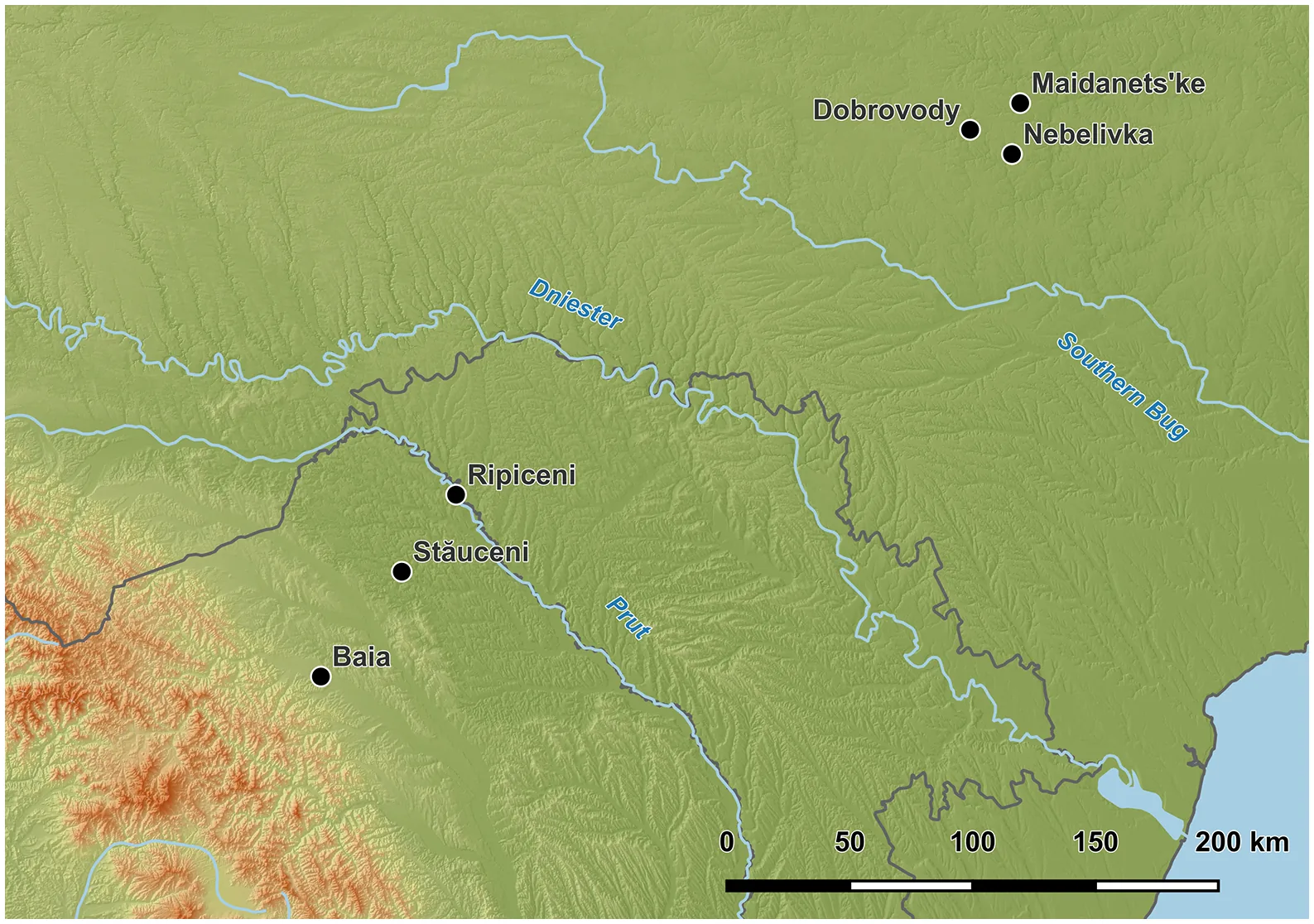
The complex stretched from the eastern Carpathians through the Prut and Dniester basins into the forest-steppe towards the Dnipro. Its centre of gravity moved. Its practices travelled unevenly.

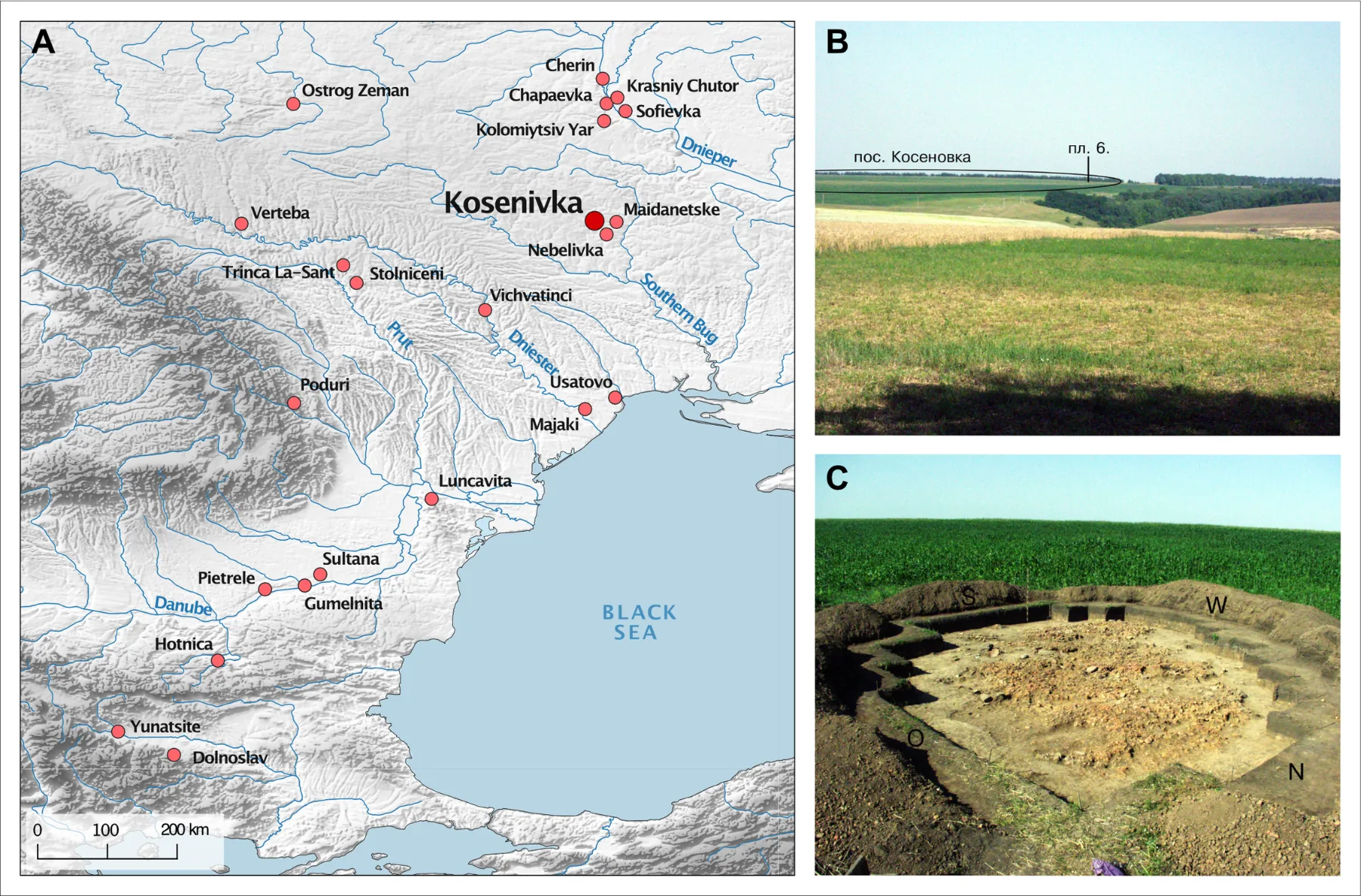
The atlas below is intentionally schematic. Modern borders orient the reader; prehistoric movement crossed them. Select a place and watch the question change—from chronology at Cucuteni, to governance at Stăuceni, to population at Talianki, to death at Kosenivka and Verteba.

Selected Cucuteni–Trypillia sites A schematic orientation map spanning Romania, Moldova and Ukraine. Points are approximate. eastern Carpathians Prut Dniester Dnipro schematic orientation · points approximate Cucuteni–CetățuiaStăuceni–HolmRipiceni–HolmPoduri–Dealul GhindaruCărbunaStolniceniVerteba CaveNebelivkaMaidanetskeTaliankiKosenivkaTrypillia
04 · The rings become enormous

What do we call a city when we cannot find its king?

In the early fourth millennium BCE, settlements in what is now Ukraine expanded to scales Europe would not see again for a very long time.

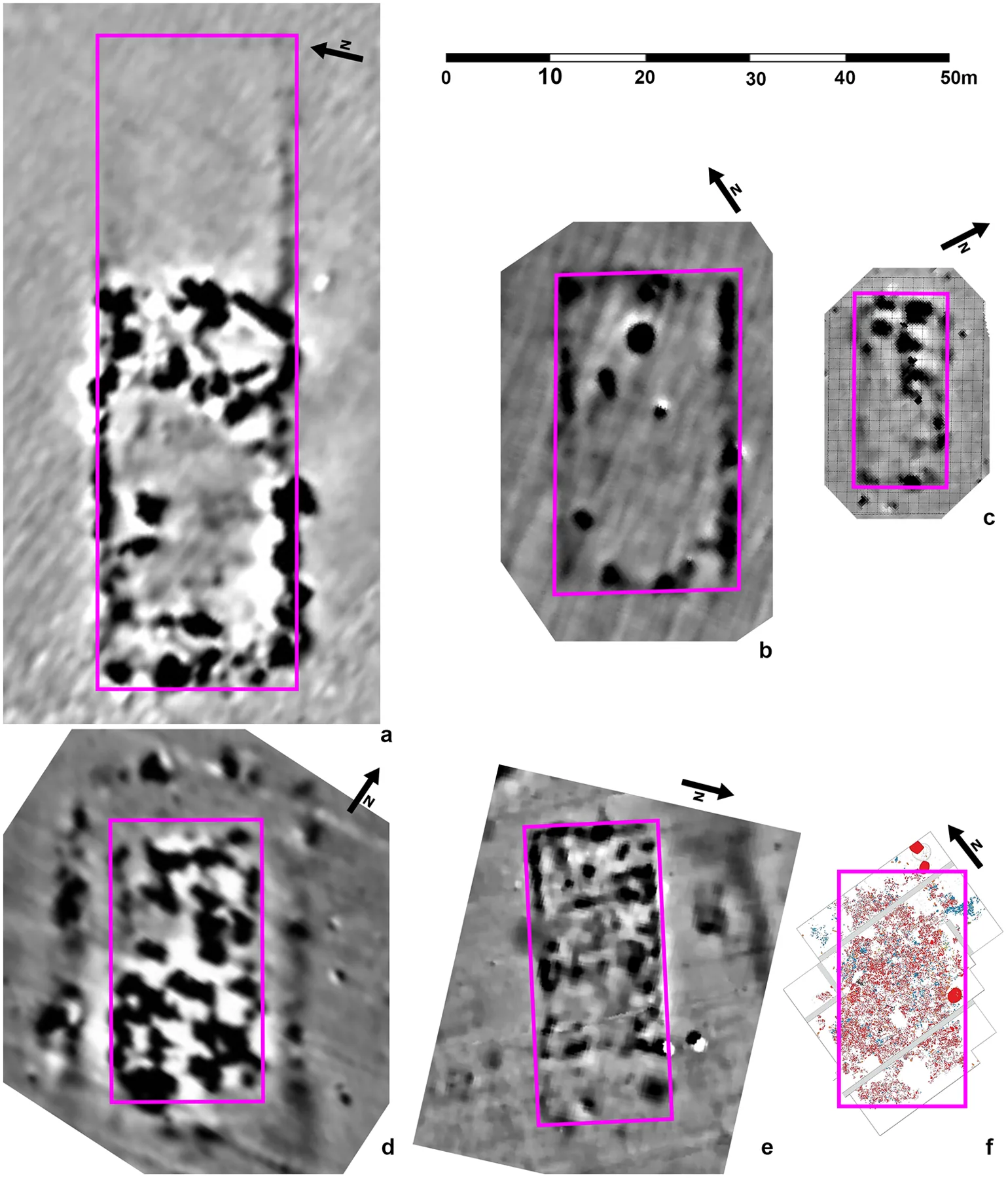
reveals hundreds or thousands of burned house footprints arranged in concentric circuits, radial passages, neighbourhood clusters and large open centres. Some mapped areas approached 300 hectares. S05 S06

The word reports settlement scale. Its social meaning remains debated. Researchers have proposed permanent low-density cities, seasonal assembly centres, pilgrimage places, regional capitals, or settlements whose intensity changed over their lifetimes. The disagreement is productive: each model predicts different food flows, waste, rebuilding, cemeteries and environmental effects.

~320 ha
upper mapped scale of the largest known settlements; boundaries and usable area vary.
~7,000
house plans used in one recent cross-site inequality study.
38
settlements compared in that house-size analysis.
0
unambiguous royal palaces securely identified across the mega-site world.

The population number is made of assumptions

A plan can accumulate every house built across a century. Population estimates depend on the share standing at the same time. Population equals mapped houses × contemporaneous share × household size. Change any term and the headline moves.

Build an estimate

The calculator shows how three assumptions produce the estimate.

5,500estimated people under these assumptions
05 · Governing without a throne

Scale is easy to see. Authority remains difficult to recover.

Aerial plans show order. They do not show who argued, persuaded, commanded, remembered obligations or cleaned the meeting place afterwards.

One 2024 study used house-floor area and the as a proxy for household inequality. Across about 7,000 structures, inequality appears to have declined as mega-sites rose, remained comparatively low for generations, then increased in later stages. S04

That is serious evidence for social levelling—but only at the scale the proxy can see. Similar houses can coexist with unequal ritual authority, gendered labour, lineage prestige, control of animals, or unequal ability to leave.

Large “mega-structures” complicate the picture. At Nebelivka and other settlements they occupy prominent junctions and differ from ordinary houses. At Stăuceni–Holm, a community of only a few hundred people constructed a building around 350 m². Was it a council hall, feasting place, ritual building, elite household, storage centre, or several things through time? Only a quarter has been excavated. S03 S05

What the ground supports

Repeated coordination

Plans, paths, rebuilding, pasture management and public-scale structures imply durable rules and collective work.

What remains invisible

The constitution

No texts name offices, voting rules, councils, coercive powers or rights. “Egalitarian” must not become a word for everything we cannot see.

06 · Feeding the circles

A city is an appetite with streets.

Every spectacular plan rests on ordinary mornings: seed, weeds, dung, grinding, water, storage, failed harvests and negotiations over where animals may graze.

from 34 settlements has replaced the old picture of an economy inferred mainly from animal bones. Wheat, barley and pulses mattered. Livestock provided meat and milk, but also manure, traction and a way to convert pasture into food. S08

At Kosenivka, a model combining human, animal and plant suggested that plants supplied most dietary protein and meat contributed less than ten per cent. The estimate applies to Kosenivka and to the evidence sampled by this model. S07

At Maidanetske, animal isotope histories suggest that access to pasture was partitioned and negotiated. Pigs may have fed in and around the settlement, converting scraps into food. Coordination lived in the daily work of keeping animals from eating someone else’s future. S09

Feed a large settlement

Includes a 35% reserve for seed, storage loss and bad-year buffering. Excludes fallow and pasture; actual land claim would be larger. Compare the formal palaeoeconomy models. S16

2,777cultivated hectares in this simplified year
Interlude · Salt

Salt is electricity made edible.

Sodium ions help cells maintain electrical gradients; nerves and muscles turn those gradients into action. Chloride helps regulate fluids and digestion. A body cannot opt out of salt.

But salt is more than physiology. It preserves food, supports animals and can concentrate exchange around places where rock or brine brings it close to the surface. In the Moldavian Subcarpathians, people exploited salt springs long before the mature Cucuteni phases, and use continued through the . At Poiana Slatinei–Lunca, repeated heating beside a still-active spring created a huge stratified deposit of ash, charcoal and burned soil. S39

Some later contexts used : ceramic equipment for concentrating brine until solid salt could be extracted. Spatial studies connect Eneolithic settlement patterns with access to salt sources. Control, exchange and consumption require additional evidence. S40

The phrase is poetic; the evidence is material. Between them sits a tiny public truth: one of history’s great exchange goods was also a prerequisite for every heartbeat. Traces of Salt follows these geologies, techniques and exchanges in detail.

07 · A grammar painted by hand

The vessels seem to move because the eye completes them.

Bands divide, reverse, thicken, disappear behind a curve and return. A static pot recruits the turning body of the viewer.

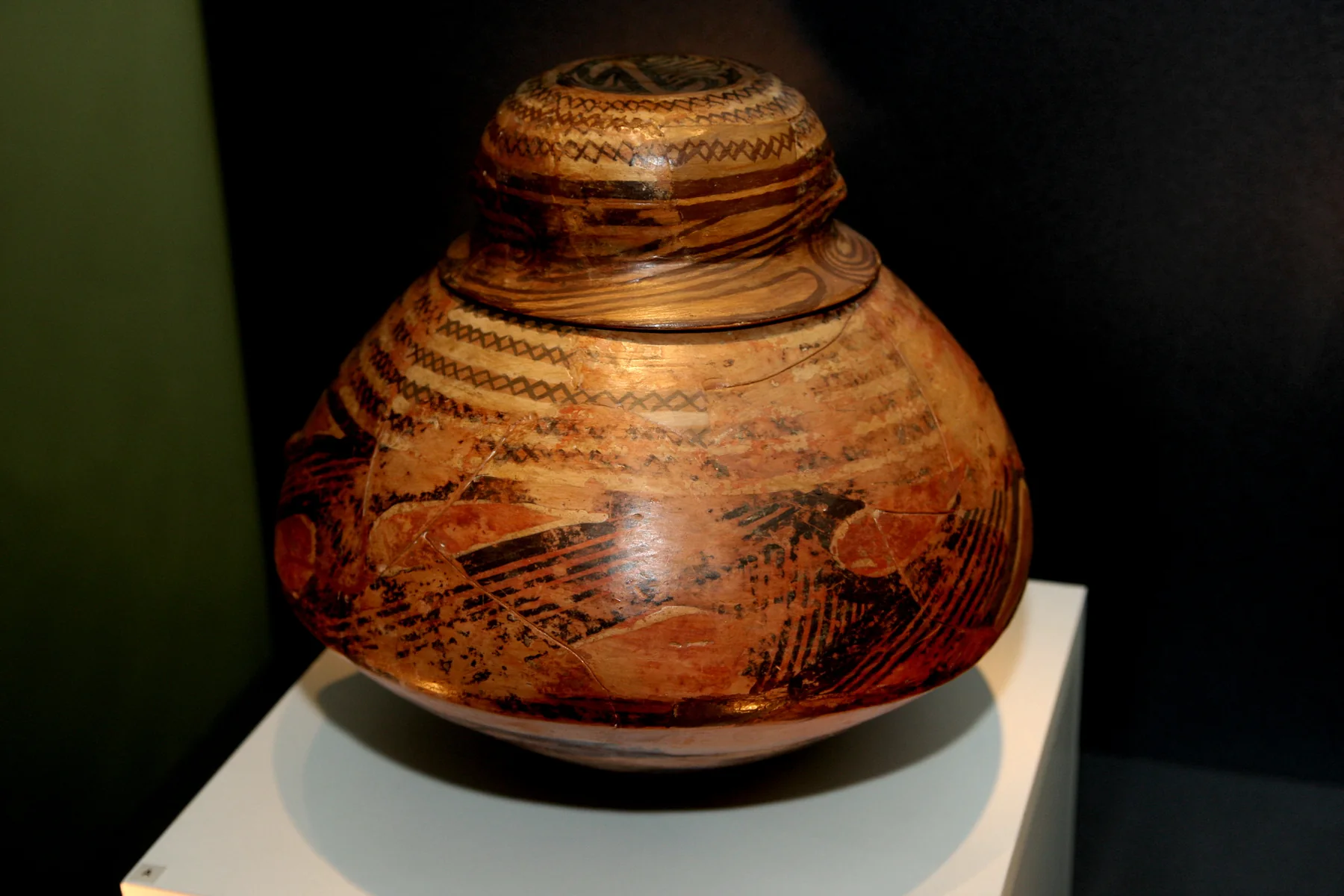
Laboratory analyses identify recipes involving iron-rich reds, light mineral grounds and dark iron- or manganese-bearing pigments. Kilns and workshop evidence show controlled production, while technological studies remind us that “Cucuteni pottery” contains local choices, skill traditions and changing supply. S18 S19 S20 S22

The abstraction rewards close looking while its prehistoric meanings remain open. Repeated signs may have carried names, stories, status, rhythm, ritual instructions—or associations our categories do not fit. Pattern is evidence of learned practice. Its status is a learned visual practice with meanings that remain undeciphered.

Compose a contemporary echo

This generator borrows formal ideas—rotation, counter-movement, thick and thin bands. The archaeological motif remains within its original object and context.

08 · Burn the house

To preserve a house for six thousand years, destroy it.

Timber disappears. Earth returns to earth. But wall clay heated hard enough becomes ceramic, preserving the negative memory of beams, surfaces and collapse.

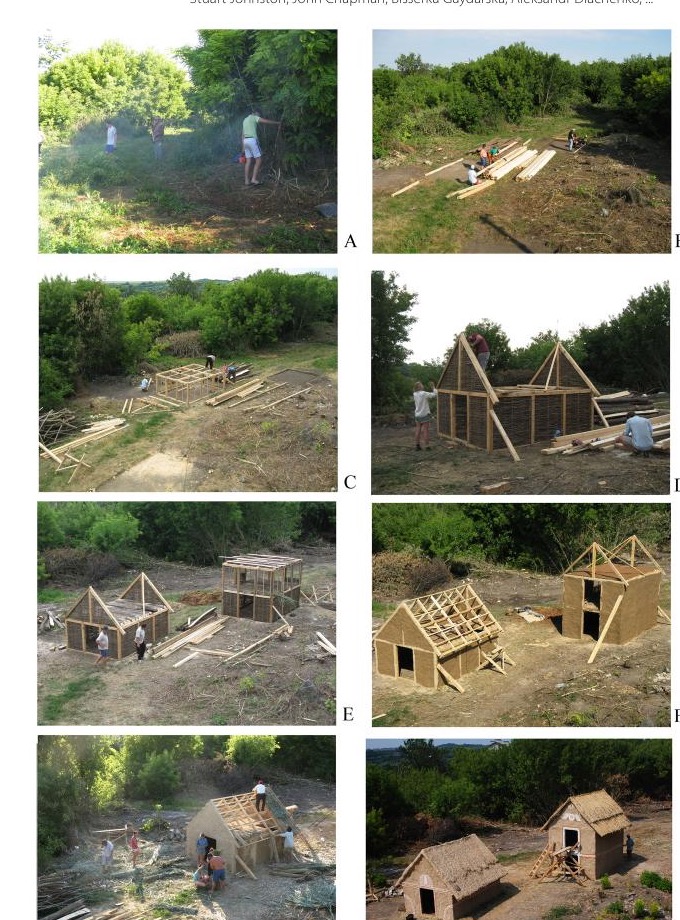
Full-scale experiments at Nebelivka tested what it takes to produce the strongly fired familiar from excavations. High-intensity burning may require five to ten times as much timber as building the house itself. That makes deliberate burning plausible for many structures. S11 S05

Purpose remains plural. A house might have been ceremonially closed, converted into an ancestral place, cleared for rebuilding, destroyed in conflict, lost by accident, or burned for reasons that changed over two millennia. Experimental archaeology can establish feasibility and resource requirements; the meaning of each fire remains tied to context.

755°Cillustrative peak derived from the model
7 hillustrative sustained phase
5–10×published experimental order of fuel relative to building timber

The moving values are deliberately labelled illustrative. The experiment grounds the order of effort; the temperature curve remains illustrative.

09 · Where are the dead?

A populous world with almost no one in it.

Thousands of houses survive as burnt outlines. Human bodies from much of the same span are astonishingly rare.

The rarity of bodies is a problem of practice, preservation and discovery, or . Bodies may have been exposed, cremated, placed in water, moved after decomposition, buried in locations not yet found, or treated selectively. Acid soils and later disturbance erase evidence. Different regions and centuries may have followed different customs.

Kosenivka is exceptional: fragments of six people, including children and adults, were recovered in a burned-house context. Possible trauma and fire damage make violent death conceivable, but the sequence of death, burning and deposition cannot be securely narrated. S07

Verteba Cave is another exception, preserving repeated deposits and the bodies that make genomic study possible. Verteba Cave represents a distinctive mortuary context with its own history of deposition. S13 S36

Imagine 2,500 expected deaths across several generations

Six highlighted dots echo the number represented at Kosenivka. Their purpose is to make scale felt across the full grid.

10 · Bodies without ethnic labels

Four genomes can tell four human stories.

Ancient DNA gives the missing dead an extraordinary new visibility. It also tempts us to make tiny samples speak too loudly.

Four late Cucuteni–Trypillia-associated women from Moldova carried substantial ancestry related to European Neolithic farmers. Three also showed considerable steppe-related ancestry, evidence for contact and admixture before the later large-scale steppe expansions. S12

Genome-wide data from Verteba Cave show heterogeneity—farmer-related, hunter-gatherer-related and varying steppe-related signals—rather than a biologically sealed population. Wider southeastern European datasets place these people inside long histories of mobility and encounter. S13 S14

estimates . Identity includes language, belonging, relationships and self-understanding. A statistical component cannot tell us what language someone spoke, which community accepted them, whom they loved, or how they understood their own origin.

The sample

Named by context

Each genome should remain attached to site, date, burial context, biological sex estimate and data quality.

The guardrail

No colour-coded peoples

Mixture charts are models of relatedness. They should never be redrawn as pure tribes moving like solid blocks.

11 · The long ending

There was no single night when the circles went dark.

Mega-sites contracted and fragmented. Household differences may have increased. Burial under mounds became a powerful new social form. Contacts across the steppe intensified. Regions changed at different speeds.

Settlement databases show a centuries-long regional decline with varied timing. Climate and land use mattered, but neither supplies a universal trigger. Very large settlements carried demanding food, fuel, sanitation and coordination burdens; the institutions that made scale possible may also have become difficult to sustain. S15 S26

“Collapse” can hide continuity. People moved, married, changed how they buried the dead, adopted unfamiliar technologies and reorganized communities. Archaeological labels end more cleanly than human lives do.

The end of Cucuteni–Trypillia describes the loss of a recognizable constellation; people continued through other settlements, practices and archaeological labels.

12 · Four objects, four cautions

Beauty opens the door; provenance and context establish what an object can testify to.

Every object carries a find history, a museum history, a photographic history and a licence. Captions separate description from interpretation.

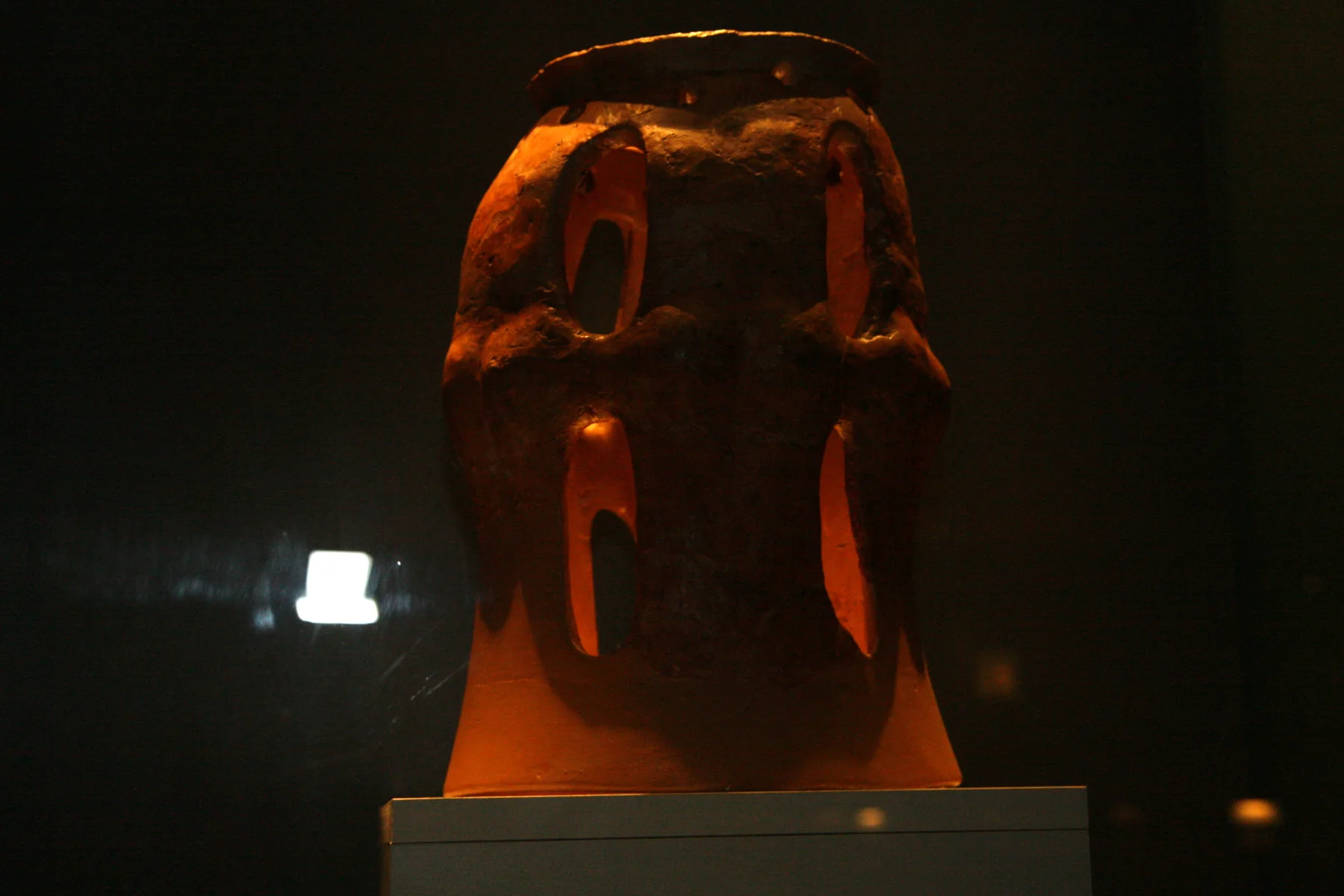
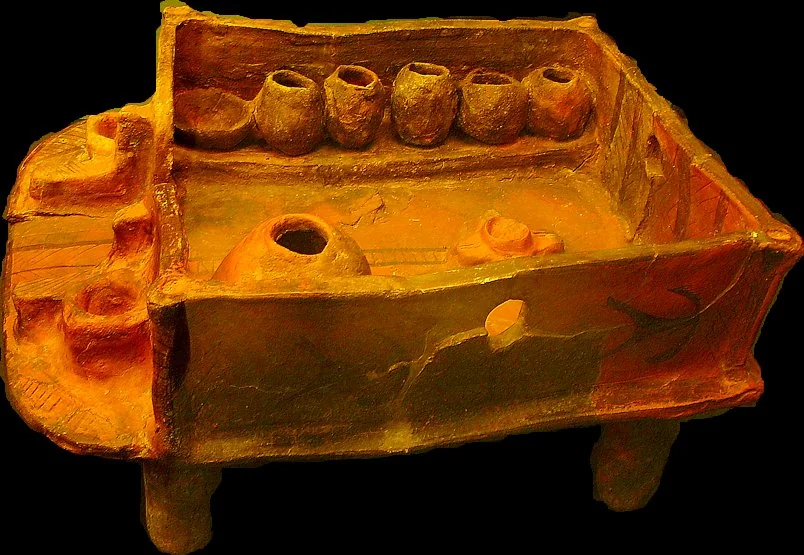
Ceramic sanctuary model from the Cucuteni cultural complex
Ceramic model conventionally described as a sanctuary. The openings and architecture are observable; “sanctuary” is a modern functional interpretation. Photo: CristianChirita, CC BY-SA 3.0 ↗.
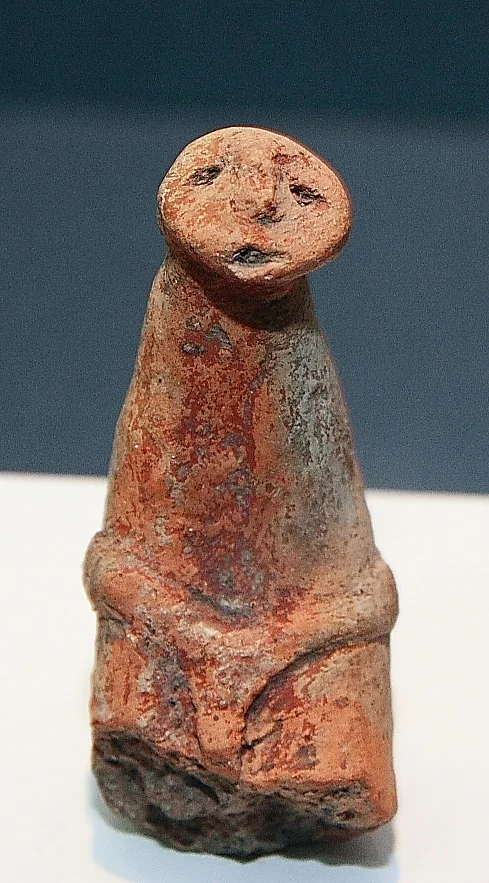
Anthropomorphic Cucuteni clay figure
Anthropomorphic clay figure, described by its source museum photograph as male. The form is observable; its role in prehistoric life remains unknown. Photo: CristianChirita, CC BY-SA 3.0 ↗.
Ceramic model of a prehistoric house
Ceramic architectural model. Models may encode ideas about buildings, households or ritual; their function and scale remain interpretive. Image: public domain derivative.
Painted Cucuteni vessel in a museum display
Painted vessel in museum display. Its lid, repair lines and painted bands are visible; the museum record supplies the exact site and phase; style alone is insufficient. Photo: CristianChirita, CC BY-SA 3.0 ↗.
13 · The afterlife of Cucuteni

Myths grow where beauty meets missing names.

Romanian public culture often gives Cucuteni superlatives, goddesses, writing, national ancestry and a perfect social order. These stories make an under-taught past emotionally available, often by compressing uncertainty into a memorable claim.

This laboratory treats them with empathy and precision. Open each claim to see what evidence permits, what wording would be stronger, and why the story continues to attract people. Public examples document how the stories circulate; the archaeological account rests on the research corpus. M01 M02 M03 M04 M05

What evidence permits

The phrase ‘oldest civilization’ mixes several archaeological measures: cities, states, writing, social complexity and chronological priority. Europe also had earlier farming communities.

Supported account

A better sentence: between about 5050 and 2950 BCE, communities across today’s Romania, Moldova and Ukraine built an unusually long-lived and internally diverse world of settlements, exchange, farming and painted pottery.

Why the story endures

The formula gives a neglected past the dignity people feel it deserves. The desire is understandable; the superlative is too blunt.

What evidence permits

The archaeological complex crossed modern borders thousands of years before Romania, Moldova or Ukraine existed. Material culture and genomes trace communities and contacts across that region; their own names remain unknown.

Supported account

People living in Romania today inherit the landscape, sites, collections and responsibility of care.

Why the story endures

National stories make deep time emotionally graspable, especially where heritage has been overlooked or claimed by others.

What evidence permits

Many figurines have conventionally been described as female, and some may have been involved in ritual. Their shapes allow several readings: divinity, toy, ancestor, teaching object or household practice. Political rule, gender and coercion require evidence from wider contexts.

Supported account

Current evidence supports diverse figurine practices and leaves the political distribution of power unresolved.

Why the story endures

The image answers a modern hunger for proof that another social order once existed. Its emotional power exceeds the material support available.

What evidence permits

Cucuteni motifs and other southeastern European signs may have carried meanings. A demonstrated writing system would also require evidence that the signs encoded language. The Tărtăria tablets come from a different archaeological context and are often blended into the story.

Supported account

The signs repeated, were learned and mattered. Their linguistic system remains undemonstrated and undeciphered.

Why the story endures

A mute civilization feels unjustly absent from history. Calling motifs writing seems to return its voice.

What evidence permits

Some Cucuteni–Trypillia phases predate Mesopotamian urban states. But southwest Asia had much earlier villages, farming and complex communities. Comparing one region’s long cultural sequence with another region’s later cities is a category mismatch.

Supported account

Ask the more interesting question: why did large settlements in eastern Europe and urban states in Mesopotamia take such different institutional forms?

Why the story endures

The comparison uses a globally familiar benchmark to make an unfamiliar world visible.

What evidence permits

Mega-sites reached extraordinary mapped areas, sometimes around 300 hectares. Population estimates depend on how many houses stood at once, how long each was used, whether occupation was permanent and how many people lived in a household.

Supported account

Several thousand inhabitants are plausible for some sites; exact peaks remain model-dependent. The slider presents the assumptions and their effect on the total.

Why the story endures

A huge number converts an abstract plan into instant awe. The scale is genuinely astonishing without pretending the census survives.

What evidence permits

Many houses were burned at high temperature, sometimes deliberately. Sites and phases differ; the evidence supports varied timing and motives including closure rites, accidents, conflict, hygiene, rebuilding or combinations.

Supported account

Deliberate house-burning mattered in parts of the complex. Its calendars and meanings varied by place and period.

Why the story endures

A repeated cleansing by fire is an irresistible image—rhythmic, total and cinematic.

What evidence permits

House-size studies suggest unusually low household inequality during parts of the mega-site phenomenon. Gender, age, lineage, labour and ritual authority lie outside this measurement.

Supported account

The evidence raises a serious question: large communities may have maintained social levelling institutions for generations without obvious palaces.

Why the story endures

The past becomes a storehouse of political alternatives. Hope makes a partial signal feel complete.

What evidence permits

Contacts, mobility and admixture preceded the end of the complex. Settlement forms changed over centuries and by region; mega-sites fragmented, mortuary practices shifted and new social networks grew.

Supported account

The two-millennia transformation combines regional change, mobility, contact and possible episodes of violence or displacement.

Why the story endures

A dramatic ending is easier to remember than slow institutional reconfiguration.

What evidence permits

Patterns were made deliberately and probably carried learned associations. Without texts or securely repeated contextual rules, modern readings of planets, DNA, chakras or hidden alphabets are projections.

Supported account

We can study symmetry, manufacturing sequence, repetition, placement and archaeological context. The surviving evidence underdetermines the meanings.

Why the story endures

Beauty creates the strong sensation that it must be saying something—and that we should be able to hear it.

14 · A shared inheritance

The modern borders are real. The prehistoric world exceeds them.

Romania, the Republic of Moldova and Ukraine are developing components of a transnational Cucuteni–Trypillia property on UNESCO’s Tentative Lists. The three Tentative List components already frame the heritage as transnational, with each country carrying part of the record. S27 S28 S29

Ukraine’s sites and collections also exist under the pressure of war, occupation, looting and interrupted research. Shared heritage gives each country a distinct responsibility for care. It is a reason to protect evidence, credit scholars and institutions in every language, and keep digital copies connected to real custodians.

RomaniaCucuteni type-site, Moldavian settlements, museums, salt landscapes and long research traditions.
Republic of MoldovaA central bridge of sites, objects and human remains across Prut and Dniester networks.
UkraineTrypillia type-site, mega-sites, Verteba Cave and much of the evidence that transformed the global debate.
15 · The living library

Every claim should be able to show its road back to evidence.

The curated corpus brings together chronology, urbanism, food, DNA, fire, environment, objects, heritage and examples of public myth-making.

“OA” means . Each card states what the source supports here; scope and conditions appear when they change the reading.

Evidence was reviewed on 21 July 2026. A new dating programme, a major genomic synthesis or a change in UNESCO status triggers the next review. Download the JSON corpus.